Which book have you read more than any other?
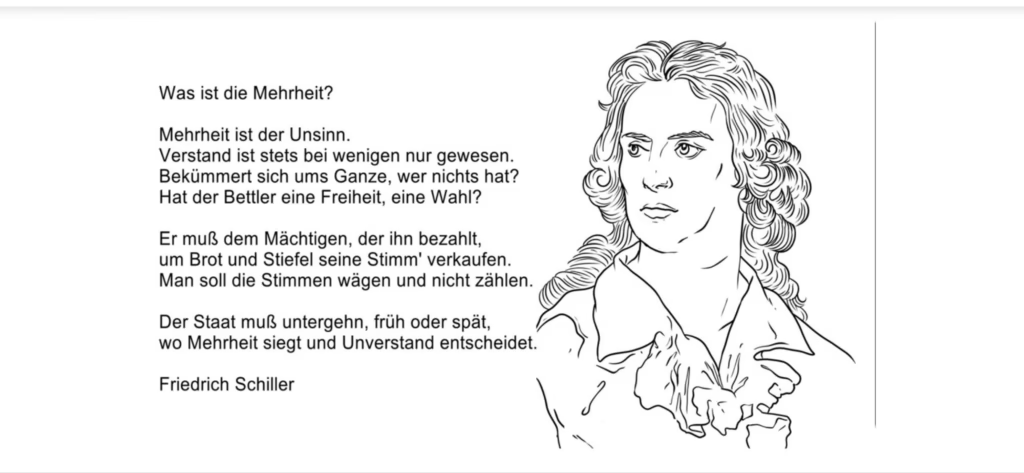
The author Johann Wolfgang Goethe read Shakespeare in English and asked his Jena friends to translate his texts into German.
He read Marlowe Dr Faustus.
Credit phb
TITLE: The Aussie Bond That Never Was: Sam Neill and the Road Not Taken
SLUG: aussie-bond-sam-neill-road-not-taken
EXCERPT: Sam Neill screen-tested for James Bond in 1986 but lost
This essay asks what a life gains by staying, deliberately, unfamous.
CATEGORY: Philosophie & Gesellschaft
TAGS: sam neill, james bond, jurassic park, new zealand cinema, antipodean cinema, stardom, obituary, bond university, Gold Coast, Robina
LANGUAGE: EN
Call him the Aussie Bond and you would already be wrong twice over
Sam Neill was never Australian, and he was never Bond. He was born in Omagh, raised in Christchurch, and forged, in the late 1970s, on the same New Wave that gave the world Peter Weir and Gillian Armstrong, a wave that ran through both New Zealand and Australia so freely that audiences abroad, then and now, rarely bothered to distinguish the two.
The only Bond with a genuine claim on this coastline, one might note in passing, sits twenty minutes inland at Robina, chartered on reinvention and polish of its own, though it asks for tuition rather than a Walther PPK.
That confusion is, in its own way, the story.
The Screen Test
In 1986, with Roger Moore gone and the franchise anxious, Barbara Broccoli went hunting for the next 007 in the antipodes. Neill screen-tested, tuxedo shirt unbuttoned, Walther PPK in hand, and by his own account it was one of the more mortifying afternoons of his career — his agent, he said later, had shoved him into it. Ladbrokes had him briefly installed as favourite. Cubby Broccoli was not convinced. The role went, eventually, to Timothy Dalton, after Pierce Brosnan’s television contract took him out of the running. Neill called the whole episode a bad dream, and meant it as relief, not regret.
What the Refusal Bought Him
Bond is a strange kind of prize. It grants a certain immortality and forecloses almost everything else — ask Dalton, whose fine, serious Bond nearly ended his career rather than making it, or ask how long it took Connery to be believed as anyone else. Neill, without quite choosing to, kept the door open. The same year as Jurassic Park made him a face recognised on every continent, he was also standing inside The Piano, a film that answered to Cannes rather than to Pinewood. He went on stacking horror against literary adaptation against television villainy against, unexpectedly, comic vineyard footage of a ferret killing an animal he had named Meryl Streep. No single frame ever became the whole of him.
The Aussie Bond, Reconsidered
There is a lazier way to tell this story, the near-miss as tragedy, the role that got away. Neill himself refused that reading to the end, and the record backs him: he built one of the longer, stranger, more genuinely various careers of his generation precisely because the door marked “movie star” closed on him early, and he did not spend the next four decades trying to prise it back open. What is left, on the day the obituaries are being written, is not a might-have-been but a life that took its own shape, Irish by birth, New Zealand by upbringing, Australian by association, and, in the end, none of the labels quite sufficient to hold him.
So the pun, in the end, runs backwards. It is not Neill who borrows Bond’s name for a moment of local colour, it is the university up the road at Robina that borrows Bond’s, betting that a name built on glamour and discipline travels well, even inland, even a continent away from Pinewood.

You must be logged in to post a comment.